

Most Environmental, Health, and Safety (EHS) teams are being asked to do more with less. That’s not just a feeling, it’s a measurable trend. According to NAEM’s 2025 EHS & Sustainability Staffing, Structure & Budget Report, drawn from nearly 150 companies, EHS budgets have decreased on a per-employee basis over the last decade, and median budgets haven’t grown at all despite years of inflation.
Meanwhile, the scope of what EHS teams are asked to own keeps expanding: air emissions tracking alone, for example, is now led by 70% of EHS respondents, and it’s grown more resource-intensive as corporate financial reporting has come to depend on it. NAEM publishes this benchmark only every few years, with the prior edition in 2020, and nothing about the broader hiring and budget environment since suggests this particular pressure has eased.
In plain terms, most EHS teams are being asked to do more with the same or fewer resources than they had years ago. For a lot of organizations, the instinctive response is to look at EHS hiring. That’s a reasonable instinct, but it’s worth pausing before committing to it, because hiring isn’t the only lever available, and it isn’t always the right one to pull.
EHS Recruiting Is One Option, Not the Only One
Searches for EHS staffing, or safety staffing more broadly, often lead to an EHS recruiting firm, an EHS staffing agency, or one of the many independent EHS recruiters offering direct hire and contract placement services, or, for senior leadership roles, an executive search firm. Those recruiting services solve a real problem, connecting open EHS roles with qualified candidates, but they’re built on an assumption that’s already been made: that hiring is the answer. This article backs up a step, to the question an EHS function has to answer first: has the workload grown to the point where existing resources are maxed out, and something has to change?
From there, an organization generally has three real options: outsource the excess workload to third-party consultants, add headcount to absorb it directly, or invest in the processes and tools that reduce how much workload exists in the first place. Hiring is the most familiar path, and outsourcing has its place for specialized or temporary needs, but the third option is the one most often overlooked, and it’s frequently the one that changes the math on the other two.
 Why the Gap Facing EHS Professionals Keeps Growing
EHS talent is harder for employers to find than it used to be, which makes the hiring process harder to rely on alone, even when the budget exists. But the NAEM data points to something structural underneath that: the workload itself is growing, in scope and intensity, faster than the resources allocated to handle it, especially for organizations managing multiple locations.
That’s not a problem that disappears once you fill an open requisition, it’s a capacity problem that a single new hire may only partially solve, especially if the underlying work, tracking regulatory changes, running inspections, managing incident data across job sites, stays exactly as manual as it was before.
What to Consider Before Growing Your EHS Team
Before opening a requisition, it’s worth separating two different problems that often get treated as the same one:
| Capacity Problem | Capability Problem | |
| What’s happening | More work than hours available | Enough hours, but the tools make the work slow and error-prone |
| How it shows up | Backlog grows even with efficient processes | Backlog grows even with adequate headcount |
| The fix | Add headcount | Invest in better tools |
A capacity problem is solved by adding people. A capability problem is usually better solved by better tools, and adding headcount on top of a capability problem, whether entry level or experienced, permanent or temporary, just means more people doing the same inefficient work, at a higher cost. The skills a new hire brings on day one matter less here than whether the underlying process itself is efficient; even strong EHS professionals can’t outrun a system that requires manual tracking of workplace safety and occupational health obligations across every site.
The Real Cost of a New EHS Hire
The recruitment process is only the beginning, and a small part, of the overall cost of EHS staffing. A fully loaded EHS hire, including salary, benefits, and other overhead, easily runs $130,000 or more annually, and that’s before the time it takes for them to build up regulatory knowledge and training specific to your sites and industry. A well-built EHS platform typically costs a fraction of that, and some, like Dakota Software’s ProActivity suite, arrives with regulatory tracking and compliance content already built in, assisting with onboarding and regulatory guidance, an essential advantage for any business trying to close the resource gap quickly.
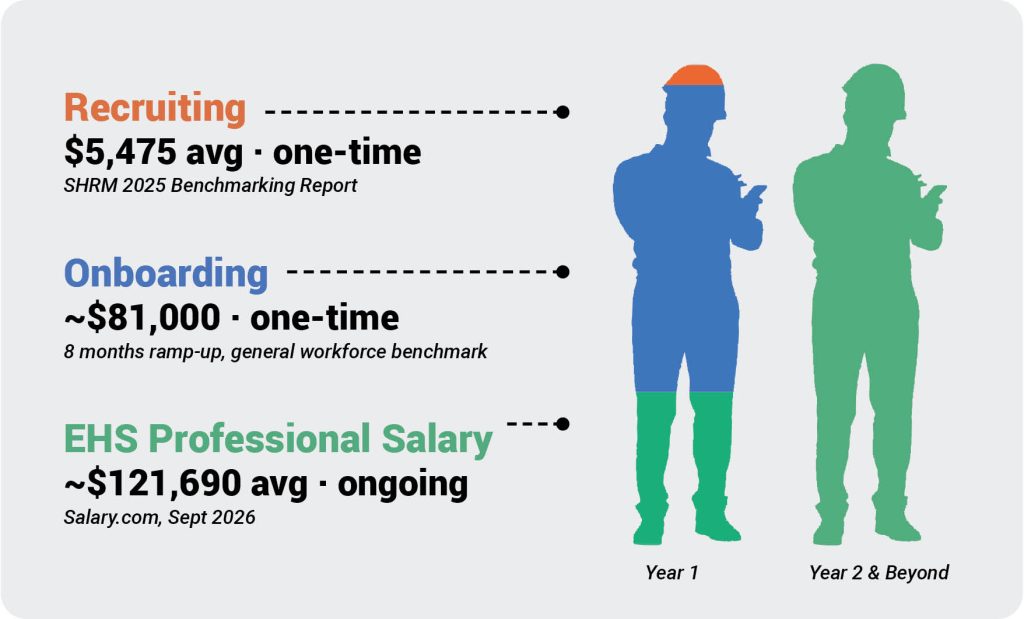
Onboarding and ramp-up carry a real cost too, especially when the information a new hire needs isn’t clearly and consistently documented. A new EHS hire, however capable, still has to learn which compliance dates actually apply and why, often starting from whatever calendar or notes their predecessor happened to leave behind, on top of acclimating to the company’s safety culture and the policies and procedures that shape its EHS strategy. Permits, in particular, are long, dense documents that take real time to work through cold. This is one of the many areas that technology can add real value.
An indirect cost that is often ignored: the loss of institutional EHS knowledge when a hire eventually leaves. The reasoning behind a compliance decision, why a permit applies the way it does at a specific site, a past history of near misses and safety issues, often lives in one person’s head, and it walks out the door when they do, regardless of how well they were paid or how long they stayed. Documenting that information, rather than relying on someone remembering it, reduces how much any single employee’s departure actually costs the organization, and gives leadership more confidence that critical compliance requirements and the expectations behind them won’t disappear along with them.
What EHS Technology Can and Can’t Replace
Technology can take the legwork out of many EHS functions, such as deconstructing those complex permits into their action-forcing tasks and audit-ready questions, giving a new employee a running start instead of a stack of paper to decode. EHS Software can help with a wide range of these types of tasks: tracking incidents and corrective actions, surfacing patterns, keeping information organized and accessible. A platform like Dakota’s ProActivity Suite goes further, though, powered by human intelligence rather than automation alone, helping a team understand complex, often ambiguous requirements and documenting why they apply to a specific site. Good technology doesn’t replace good EHS people, it makes their expertise go further.
None of this is an argument that software solves every EHS staffing problem, it doesn’t. Physical presence across day-to-day operations, the judgment calls that come from years of hands-on experience, and the work of building a genuine safety culture across a workforce aren’t things a platform can do on its own. Tools are a support system and force multiplier for the people already in the building, expanding what a smaller team has the ability to do and helping secure better outcomes, not a substitute for having real EHS expertise on staff.
Key Question Before Direct Hire for EHS Roles
Should an EHS Director or Safety Professional Add to their EHS Team or Invest in Software?
It depends on which problem you actually have. If there’s simply more work than any number of tools can absorb, more people, more hours, more hands, hiring is the right call. If the real issue is that regulatory tracking, inspections, or compliance recordkeeping are slower and more error-prone than they should be, a better platform is often the faster, more cost-effective fix, and it can make the team you already have significantly more productive without getting an EHS recruiting company involved at all.
For most organizations, the answer isn’t ‘hire’ or ‘buy software,’ it’s finding the right fit between the two, sized to whichever problem, capacity or capability, is actually driving the gap.
See how Dakota’s compliance planning tools give a lean EHS team the regulatory depth of a much larger one, or request a demo to see what that actually looks like.