
Regulations and permits tell an EHS team which obligations require action, including which inspections it has to conduct and how often. They don’t tell the team where to concentrate its inspection efforts. Those same teams are also managing incidents, training, audits, and regulatory change with limited hours, so something has to decide where the extra attention goes.
Picture a site with an accurate compliance calendar, where every required inspection is scheduled and completed on time. Meanwhile, an aging piece of equipment with a long history of small repairs quietly accounts for most of the near misses and is a likely candidate for an equipment failure, yet it’s inspected exactly as often as the equipment around it. Nothing is out of compliance and the calendar is doing its job, but the team has no structured way to see that risk is concentrating in one place.
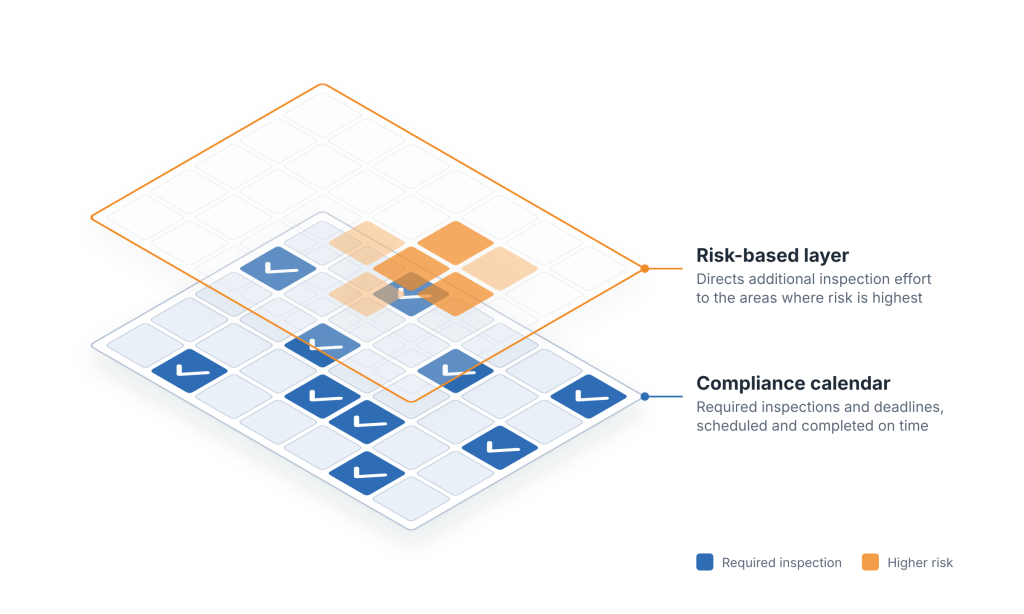
That’s the gap risk-based inspection scheduling fills. It doesn’t replace the compliance calendar. It reinforces it by helping a team direct inspection activities toward the areas that matter most.
What Regulations Decide, and What They Leave Open
A compliance calendar built from applicable regulatory requirements is the foundation of an inspection program. It establishes which inspections are required, when they’re due, and which regulatory changes need review, so mandated work doesn’t slip. None of that is optional, and a risk-based approach doesn’t change it.
What a calendar can’t do on its own is decide how to use everything else a team has: the time left after mandated work is done, how deep any given walkthrough should go, which internal inspections are worth adding, and which findings to chase first. Those are judgment calls, and with limited resources, they largely determine a program’s effectiveness.
 What Is Risk-Based Inspection Scheduling?
Risk-based inspection scheduling is the practice of setting the frequency and depth of inspection activities according to the risk level an area, activity, or piece of equipment presents — in other words, how likely is it that something will go wrong and how serious would the resulting outcome be. Higher-risk areas, activities, and equipment get more frequent or more thorough attention, while those with lower risk get somewhat lesser consideration. The goal is to focus limited EHS resources on where the potential for harm, violations, and penalties is greatest.
One clarification is worth making: risk-based inspections work above required inspections, not in place of them. Fixed-interval requirements, such as those for fire extinguishers or cranes, and inspections tied to permit conditions stay exactly as they are. Risk-based scheduling decides where to go deeper, not what to skip.
| Compliance Calendar | Risk-Based Layer | |
| Answers | What must be inspected, and when | Where to concentrate additional attention |
| Driven by | Regulations, permits, and applicable requirements | Criticality, history, and consequence |
| Covers | Mandated inspections and deadlines | Internal inspections, depth, and follow-up priorities |
| Result | Required work is complete and on time | Limited effort goes where exposure is greatest |
Where API RP 580 Risk-Based Inspection (RBI) Fits
For oil and gas, petrochemical, and other process industries, including chemical plants, risk-based inspection (RBI) has a more formal counterpart: API RP 580, Elements of a Risk-Based Inspection Program. It’s a recommended practice for pressure-containing equipment such as pressure vessels, piping, storage tanks, and pressure relief devices. The RBI methodology estimates the probability of failure and the consequence of a loss of containment for each equipment item, then uses that estimate to set the inspection plan. Understanding the damage mechanisms at work, sometimes called degradation mechanisms, such as corrosion or cracking, and the failure modes they lead to is central to that RBI analysis. RBI focuses effort on the equipment in service where the combination of likelihood and consequence is highest, with asset reliability as a goal alongside safety.
That work, typically owned by inspection and asset-integrity specialists, supports mechanical integrity programs and operates alongside codes like API 510, 570, and 653.
The overlap with everyday EHS inspections is the logic and the program around it. Both match inspection efforts to risk. RP 580 also treats RBI as a managed program, with documented methods, reliable data, qualified people, and reassessment as conditions and process changes occur. Common summaries of the standard point to limitations such as missing or inaccurate data, plans that aren’t carried out, and findings that aren’t followed up on. Those are program-management problems, not engineering ones, and they’re where a plan-do-check-act approach helps: plan inspections around risk, carry them out, check the results, and act on what’s found so the next round starts better informed. It’s also why RBI implementation depends as much on follow-through as on the analysis itself.
Why Limited Resources Make Risk Assessment a Priority
When inspection efforts are spread evenly, the highest-risk topics get the same attention as the lowest. That’s harder to defend as sites, equipment, and requirements multiply.
Compliance risk, meaning violations and penalties, and operational risk, meaning injuries, downtime, and lost asset reliability, both tend to cluster in a handful of places: a certain asset type, a certain process, a certain site. Concentrating attention there reduces exposure on both fronts.
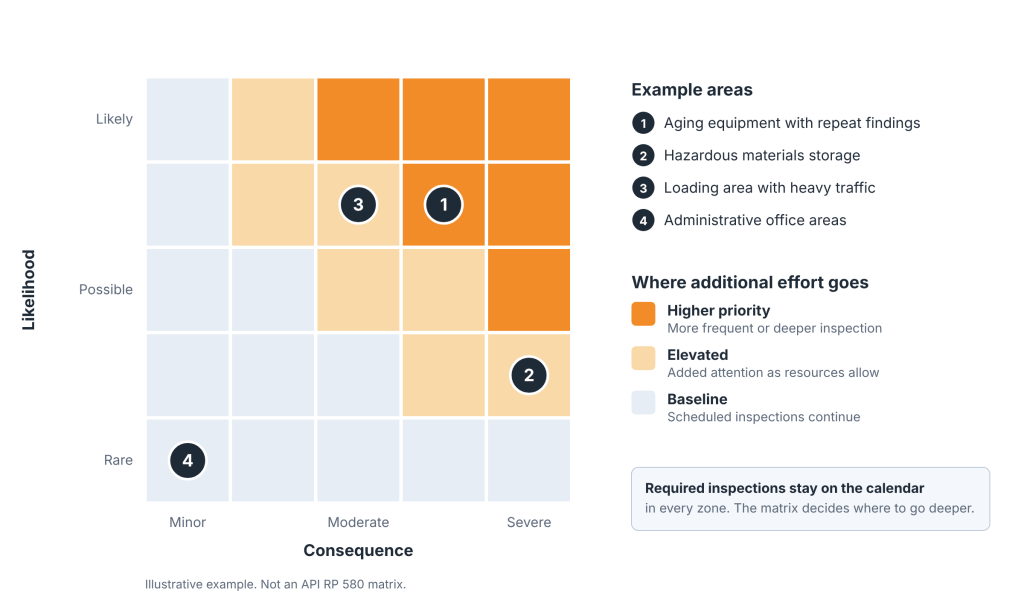
That only works if the ratings are honest. People tend to be conservative about safety, so when risks are rated by instinct, both likelihood and consequence drift upward. If more than half of the identified risks land in the upper right of a risk matrix, the ranking stops helping, because there’s no clear place to start. Practitioners who have run these exercises will recognize the pattern.
 The challenge isn’t deciding that prioritization is a good idea. It’s identifying where the risk actually is.
Knowing Where Your Risk Is: Structured Data Capture
Any risk assessment is only as good as the information behind it. Findings recorded in notes, spreadsheets, or paper checklists are hard to compare, so patterns stay invisible. Structured data capture changes that. When inspections, incidents, near misses, and observations are recorded with the same fields and the same categories every time, a team can see how findings cluster by site, by topic, and by asset type.
How an inspection question is written matters here too. A yes/no item captures a condition but not whether it’s been seen before. Correction vs. Corrective Action covers how to design inspection questions that surface repeat findings, and it applies directly to building a data set a risk-based approach can use.
Tools That Turn Data Into a Risk-Based Inspection Plan
Structured data only helps if someone can analyze it at the scale of an entire program. That’s where technology earns its place, by surfacing the patterns a team would otherwise have to piece together by hand: repeat findings at the same location, regulatory topics with a high concentration of issues, overdue corrective actions, and trends over time.
A risk assessment typically weighs factors such as:
- Criticality: how essential the asset or process is, and how serious an equipment failure would be
- Failure and incident history: repeat findings, near misses, and past incidents tied to the area
- Consequence severity: the potential impact on people, the environment, and operations
- Regulatory sensitivity: how closely the area is tied to requirements with significant penalty exposure, such as those involving hazardous materials
- Time since last inspection: how long it’s been, and what has changed since
Many teams plot likelihood against consequence on a simple risk matrix to rank areas, then revisit the ranking as new findings come in. The EHS Compliance Calendar is the natural starting point, since it establishes the required inspections these risk signals build on.
Putting Site Leaders in the Driver’s Seat
A site leader who understands the unique risk profile of their operation is often the best person to decide where additional effort goes. They know which equipment is aging, which process changed last quarter, and which area has a pattern of close calls. With a structured view of the site’s own data, they can act on that knowledge instead of waiting for direction from corporate or defaulting to an even spread.
There’s a safety culture benefit as well. When leaders can see where risk concentrates and visibly act on it, the team sees that the program is looking at real exposure, not just ticking boxes. Tools don’t create that culture, but they make it much easier for a leader to lead this way.
Building a Risk-Based Inspection Program on Accurate Obligations and Informed Priorities
The two layers fit together. The compliance calendar keeps required inspections and deadlines on track, and risk data directs additional scrutiny to where it will matter most. Findings from both feed back into the picture, so the next round of priorities is better informed than the last. That feedback loop is continuous improvement in practice, and it’s what turns a one-time risk assessment into a lasting RBI program. The Key Differences Between Audits and Inspections is a useful companion for teams deciding how each activity fits into that cycle.
For organizations with limited resources, that combination is how a program stays compliant and gets more effective without adding headcount.
Accurate compliance obligations are where it starts, and structured inspection data capture and analytics are what let a team focus beyond them. See how Dakota supports both, or request a demo to see it firsthand.