
For anyone who has been tasked with selecting and implementing EHS software, you know how challenging the process can be. Months of scorecards, meetings, product demos, and budget approvals, then a rollout that takes months more, all while the regular work of compliance tracking, employee safety, and risk management carries on.
That’s what makes it so painful when, a year later, sites have quietly gone back to their spreadsheets and other manual processes.
EHS software implementations rarely fail at go-live. They fail afterward, when people stop trusting the system enough to keep using it. That makes adoption the real test of EHS software deployment. Many organizations come to Dakota Software after an implementation falls short, and while the reasons vary, one comes up more often than any other: regulatory content that goes out of date.
What Implementation Failure Actually Looks Like
Failure seldom announces itself. The EHS software is active and the rollout plan is officially complete. The EHS implementation team may have even visited sites, running hands-on training as the system went live. At the time, site staff seemed to embrace the new product. They even seemed enthusiastic. So, what went wrong?
The drift begins slowly. Tasks don’t get marked complete even when the work is done. Safety management communications start arriving by email instead of as notes in the product, and incident tracking falls behind. Site teams complain that compliance calendars and inspection checklists are out of date. Next, corporate leaders start seeing red flags in their risk management dashboards, and compliance monitoring across multiple sites gets harder to trust. Repeated calls to site leaders to get their teams engaged become commonplace, and start to feel like nagging. Soon the frustration boils over and the finger pointing begins.
The issue is rarely the feature set or user interface. The EHS software never became the place where the work gets done.
Many Reasons EHS Software Implementations Struggle
Every organization’s experience is different, and so are the causes of a failed implementation. Understanding the common hurdles to adoption is the first step toward success. These are some of the ones we hear about:
- Goals that were never clearly defined, which makes it hard to judge whether the EHS software is improving operational efficiency or helping reduce risk.
- Customization that replicates old EHS processes instead of making use of the new system’s design. Customization is valuable when it supports a goal, and it works best after teams have lived with the system as designed.
- Underestimated change management and data migration, from leadership messaging to moving historical records over from existing systems.
- Features that don’t serve the goals, or a user experience that doesn’t suit the site staff using it every day.
- A solution built for one department’s immediate need, which leaves environmental performance and health and safety management processes in separate systems.
- Lack of ongoing support after go-live, such as a 24/7 knowledge base, live support, and customized training plans, so questions go unanswered and new staff are never fully onboarded.
- Regulatory content that goes out of date, which erodes site staff’s confidence in the tasks and checklists they rely on.
Each of these is worth planning for but, in our experience, the last is often the most damaging. When the compliance activities and regulatory guidance behind the system fall out of date, site staff lose confidence in it, and once trust is gone, a drop-off in usage inevitably follows.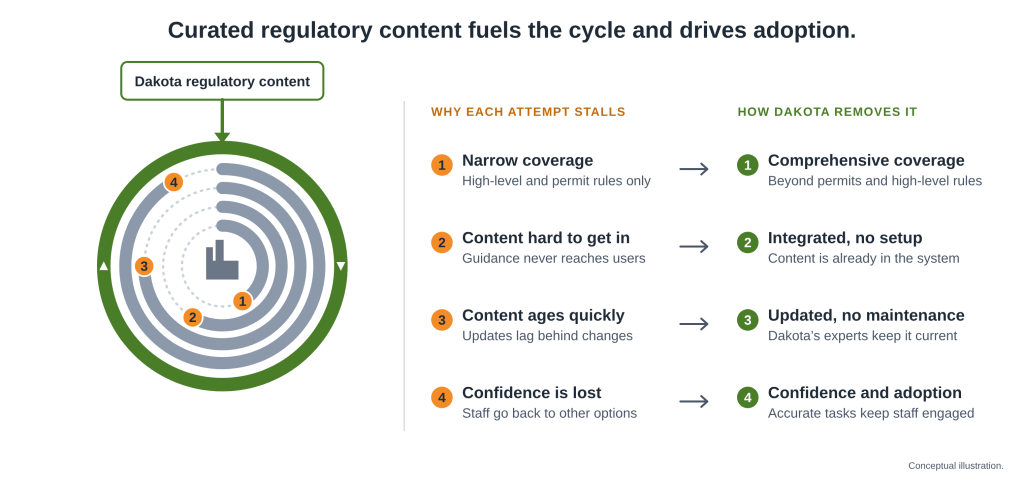
Why Compliance Management Breaks Down When Regulatory Content Goes Stale
Dakota estimates there are roughly 100,000 action-forcing federal requirements, with around 5,000 revised each year, before adding state rules, local permits, and an organization’s own management-system requirements. Keeping up with regulatory compliance at that scale is often a full time job.
Audit programs also require that organizations monitor regulatory compliance requirements. Whether an organization chooses to conduct audits with a dedicated audit team, through site self-assessments, or as management system audits, a successful review starts with knowing which requirements apply and what they actually say. Checklist questions, guide notes, and standards keep audits consistent and accurate only when they reflect the current requirements. If the underlying content is out of date, the assessment is measured against yesterday’s rules.
Site staff notice first. When tasks no longer match what they see on the ground, or arrive in volumes that don’t reflect their site’s priorities, they stop trusting them, and then they stop using the system.
Keeping Regulatory Content Current Inside the System
There are many ways to keep regulatory content current, and each comes with its own challenges. A dedicated internal team is the most common, according to a poll during a recent webinar on strategies for successful EHS and ESG software implementation, where the most common answer to how attendees track changes in regulatory requirements was an internal team. But that work can consume significant time, competes with incident reporting, audit management, and employee training, and depends on specific people staying in the role. Third-party consultants bring expertise at an ongoing cost, and someone internal still has to confirm what each change means for each site. Many EHS software systems integrate with third-party content providers, but the mechanism for keeping that content current, and for users to track and adjust to changes, is inconsistent and prone to errors.
In each case, a change doesn’t reliably reach site staff on its own. Someone has to notice it, make the update in the EHS software, work out which facilities and tasks are affected, and find the time to do it. Any gap in that chain leaves a site working from stale tasks, calendars, and compliance documents. The alternative is a digital solution that makes the change notification part of the system itself, so reviewing and updating happens consistently and doesn’t depend on anyone’s memory. 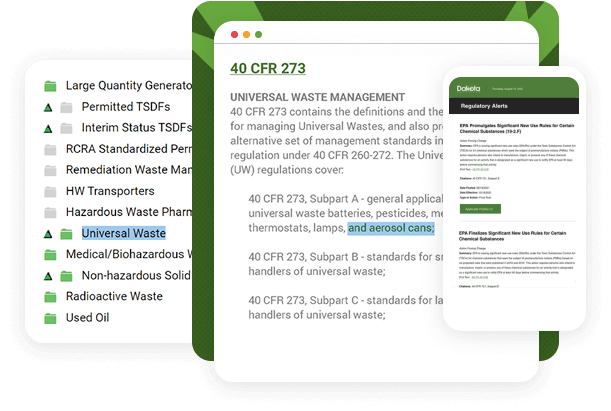
That’s how Dakota Software approaches it. Its regulatory database is maintained by in-house regulatory experts and updated monthly. In Dakota Profiler, regulatory changes are highlighted in the product, prompting users to review changes and update related tasks. In Dakota Auditor, change notifications show which topics have changed since the last audit, providing updated checklists and guidance for all relevant EHS obligations.
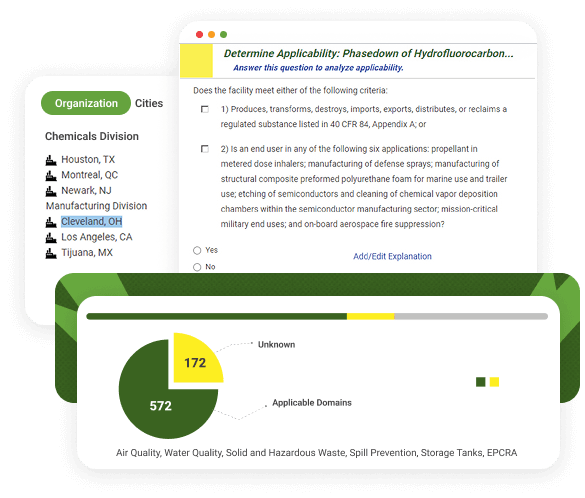
The effect on adoption is direct. Site staff see tasks that reflect their facility and its current requirements, which builds confidence that the work they’re doing supports compliance and helps mitigate risks. Hazard identification and incident management happen in the same system, so what site staff find in the field feeds back into the tasks they work from. That’s the continuous improvement loop EHS professionals are looking for: requirements drive tasks, workplace incidents prompt corrective actions, and those actions are tracked to closure. It also improves operational efficiency, since site teams spend their time on the tasks that matter instead of double-checking the list.
Questions EHS Professionals Should Ask About Their Own Implementation
- Are your goals defined well enough to measure, and do the features in your EHS management software serve them, from incident reporting to risk assessment?
- Do site staff have ongoing support after go-live, such as training and a knowledge base, as people join and change roles?
- Does your configuration follow how the new system is designed, or does it mirror your old EHS processes?
- Do your environmental management and health and safety teams share one EHS system and one organizational structure?
- Did your change management plan and data migration from existing systems hold up after go-live?
- Who owns compliance management tasks like keeping regulatory content current, and what happens when that person is unavailable?
- When a regulation changes, how does it reach a task at the site level, and how long does it take?
- Do site teams trust their task list enough to rely on it for regulatory compliance, or do they keep their own?
Why Companies Come to Dakota After Their EHS Management Software Falls Short
Many organizations come to Dakota after an EHS software implementation failed to meet their expectations. The reason is often the same: the prior vendor didn’t integrate regulatory content well, and over time that became the central issue. The content was hard to get in, out of date by the time it was, and disconnected from what each site needed to do.
Regulatory content integration isn’t the only factor in a successful EHS software implementation. Companies must also consider robust data analysis and reporting tools for tracking everything from training management to workplace safety performance, and most enterprise platforms offer them. But for higher risk organizations with compliance-driven EHS programs, maintaining regulatory requirements is among the hardest issues to fix after the fact. That’s worth considering when scoping the right EHS system and evaluating total EHS software cost.
Frequently Asked Questions
Why do EHS software implementations fail? Most fail on adoption, not features. Causes vary by organization, from unclear goals to heavy customization to underestimated change management, but a common one is regulatory content that goes out of date, which erodes site staff’s confidence in the system.
How long does an EHS software implementation take? For an organization with 15 to 20 locations, a structured implementation typically takes about three to four months. Larger or more complex organizations usually stage the rollout, starting with a pilot location and expanding by division or business unit.
How often does regulatory content need to be updated? Regulations change throughout the year, so compliance processes need continuous review, not an annual project. Dakota’s database is updated monthly, and users are prompted to review the changes that affect their facilities.
Curious how regulatory content can stay current, site-specific, and part of everyday work? See how Dakota’s ProActivity Suite supports compliance planning, or request a demo to see it firsthand.