
Navigating regulatory complexity and sustainability expectations in heavily regulated industries is more demanding than ever. Environmental, Health, and Safety (EHS) management has evolved from a compliance exercise into a strategic pillar for modern enterprises.
Yet, with all the talk of dashboards, analytics, and automation, organizations need to remember that an EHS Management System (EHSMS) is not software but rather a framework—a structured combination of policies, procedures, responsibilities, and improvement cycles that drives consistent, sustainable performance.
EHS software can enhance how this framework is executed, but it does not replace the management system itself. The system is the strategy; software is the technology that enables it.
This article explores what an EHS Management System truly is, how it’s structured around the Plan-Do-Check-Act model, and how software tools like Dakota’s ProActivity EHS Software help organizations implement and strengthen these systems across their operations.
Understanding the EHS Management System Framework
 An EHS Management System provides a widespread approach for managing risks, achieving compliance, and driving continual improvement in environmental, health, and safety performance. It’s the foundation upon which policies are built and responsibilities are defined, connecting leadership priorities with frontline practices.
Purpose and Scope
An EHSMS ensures that every employee, process, and site operates under a shared set of standards. It helps companies:
- Identify and control EHS risks.
- Ensure compliance with legal and regulatory obligations.
- Promote safe work environments and environmental stewardship.
- Integrate EHS considerations into day-to-day business decisions.
This framework aligns with international standards such as ISO 14001 (Environmental Management Systems) and ISO 45001 (Occupational Health and Safety Management Systems), both of which emphasize leadership involvement, accountability, and continual improvement.
Core Components
A strong EHS Management System includes:
- Policies and objectives that demonstrate leadership commitment.
- Defined roles and responsibilities across the organization.
- Risk and opportunity assessments to prioritize action.
- Documented processes and controls to ensure consistency.
- Training and communication to engage employees.
- Monitoring and performance evaluation for accountability.
- Corrective and preventive actions for continuous improvement.
Together, these components form the blueprint for operational excellence—a living framework that connects compliance with culture.
The Plan-Do-Check-Act (PDCA) Cycle
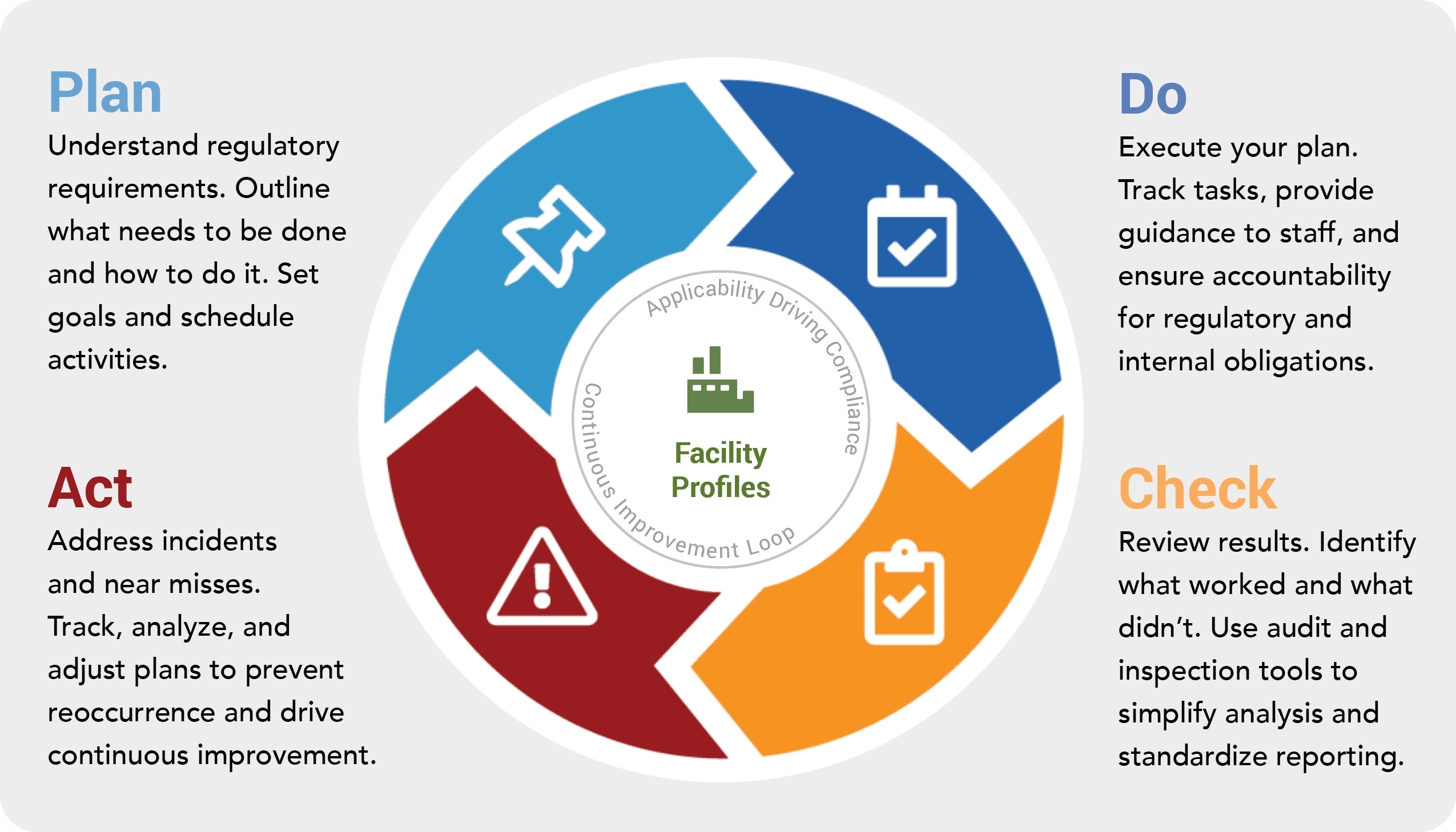
The PDCA model is the backbone of every effective EHS Management System. It represents an iterative cycle of planning, implementing, monitoring, and improving performance.
| Stage | Purpose | Example Activities |
| Plan | Identify risks, compliance obligations, and EHS objectives. | Conduct environmental aspect assessments, define safety goals, and map regulatory requirements. |
| Do | Implement plans and allocate resources. | Train employees, document procedures, perform hazard controls, and establish emergency plans. |
| Check | Evaluate performance and identify gaps. | Conduct audits and inspections, review incidents, and measure KPIs such as injury rates or emissions. |
| Act | Implement corrective actions and drive improvement. | Update policies, revise training programs, and adjust objectives based on results. |
This cyclical approach creates a culture of accountability and learning. Each cycle builds on the last, allowing organizations to evolve their EHS performance rather than just react to compliance requirements. In other words, PCDA is what turns compliance management from a defensive activity into an offensive strategy for proactive improvement.
Benefits of a Well-Structured EHS Management System
A comprehensive EHS Management System offers value far beyond regulatory compliance. By integrating EHS into every level of operations, organizations achieve both tangible and cultural benefits.
1. Improved Compliance and Risk Reduction
A defined system ensures that regulatory requirements are identified, assigned, and tracked consistently. This reduces the risk of violations, fines, or safety incidents while improving organizational readiness for audits and inspections.
2. Enhanced Safety Culture
An EHSMS promotes shared ownership of safety. When leadership, supervisors, and workers understand their roles and responsibilities, compliance becomes a collective goal rather than a siloed task.
3. Operational Efficiency
Standardized processes and continuous improvement reduce redundancy and streamline workflows. Organizations save time and resources by eliminating manual processes and focusing efforts on high-impact areas.
4. Reputation and Stakeholder Trust
Transparency and accountability strengthen relationships with regulators, investors, and communities. Companies that demonstrate consistent EHS performance enhance their brand reputation and attract socially conscious partners.
5. Foundation for ESG and Sustainability
A robust EHSMS provides the verified data and management practices needed for accurate environmental, social, and governance (ESG) reporting, turning compliance data into strategic insight.
 How EHS Software Supports the Management System
While the EHS Management System defines what must be done, EHS software defines how to do it efficiently. Technology provides the infrastructure to operationalize the framework, ensuring consistency, accountability, and transparency across complex enterprises.
Digital Enablement for a Human-Driven Framework
EHS software helps translate the principles of an EHSMS into daily practice by:
- Centralizing data: Consolidates permits, audits, incidents, and training in one location.
- Automating compliance tasks: Schedules inspections, sends reminders, and ensures timely corrective actions.
- Standardizing processes: Aligns procedures across sites for consistent execution.
- Enabling visibility: Provides dashboards and KPIs that help leaders track performance in real time.
- Maintaining accountability: Logs user activity and documents versions to support traceability and audit readiness.
These capabilities do not replace the EHSMS; they strengthen its execution—making it easier to maintain discipline across global operations.


Control Regulatory Risk with Dakota Software
Regulations don’t stand still, and neither should your compliance program.
Dakota’s ProActivity Suite quantifies regulatory exposure, centralizes compliance activities, and helps safeguard operations.

Dakota’s ProActivity EHS Software: A Connected Ecosystem
Our ProActivity EHS Software exemplifies how digital tools can support every phase of the PDCA cycle:
| Module | Purpose |
| Profiler | Builds facility-specific compliance profiles and regulatory registers. |
| Auditor | Centralizes audit programs and provides plain-language audit protocols. |
| Tracer | Manages tasks, corrective actions, and compliance calendars across sites. |
| Scout | Delivers advanced analytics and dashboards to measure EHS performance enterprise-wide. |
| Insights | Delivers advanced analytics and dashboards to measure EHS performance enterprise-wide. |
| Inspections | Simplifies creation and scheduling of site inspections using curated OSHA and EPA question sets. |
Together, these tools digitize and enhance each element of the management system, transforming data silos into a unified compliance and sustainability ecosystem.
For example, when an incident occurs, it can trigger an audit or inspection task in the same platform, complete with root cause analysis and corrective action tracking. That corrective action may, in turn, update the compliance calendar or flag a training need, maintaining continuity across every phase of the EHS lifecycle. This closed-loop visibility prevents issues from slipping through the cracks and helps organizations continuously improve performance.
Our ProActivity EHS Software follows this integrated approach. It unites all critical EHS management functions under one digital roof:
Sustainability in the Context of EHS Management Systems

When an EHS management system is implemented effectively, the result extends far beyond regulatory compliance. The outcome of sustainability in context to an EHS management system is measurable sustainability, which is driven by reduced environmental impact, enhanced operational accountability, and credible data that feeds into corporate ESG reporting. Modern EHS platforms make sustainability not just a value but a verifiable, data-backed outcome of everyday business operations.
1. Reduced Environmental Impact
By centralizing compliance and environmental data, organizations can identify inefficiencies that contribute to emissions, waste, or resource overuse. For example:
- Monitoring energy and water consumption at the facility level highlights opportunities for conservation.
- Tracking waste streams or air emissions enables proactive control measures.
- Automating environmental inspections ensures continuous adherence to permit conditions.
- Analyzing historical performance trends helps identify high-impact areas and prioritize sustainability initiatives that deliver measurable results.
These improvements allow companies to minimize their footprint while maintaining productivity—a key indicator of mature sustainability performance.
2. Stronger Social License to Operate
Public expectations for environmental and social responsibility are higher than ever. Organizations that demonstrate transparency in their EHS and ESG data earn greater trust from regulators, investors, and local communities. A strong EHS management system supports this by ensuring:
- Consistent safety performance and employee well-being.
- Documented adherence to environmental laws and community standards.
- Transparent corrective actions and performance reporting that show accountability in action.
When stakeholders can see that an organization manages risk responsibly and prioritizes sustainability, they are more likely to grant that organization the social license to operate, which gives a competitive advantage in industries that are under public and regulatory scrutiny.
3. Credible ESG Data for Reporting
The quality of ESG reporting depends on the integrity of the underlying ESG data. Without accurate inputs, such as energy use, emissions, waste generation, and safety metrics, ESG disclosures risk being incomplete or misleading. Integrated EHS management systems ensure that data is:
- Collected consistently across sites.
- Verified through audit trails and version control.
- Linked directly to operational activities for traceability.
This verifiable foundation not only supports compliance with ESG reporting frameworks such as GRI, SASB, or CSRD, but also enhances internal decision-making and investor confidence.
4. Link Between EHS Management and ESG Performance
EHS and ESG are two sides of the same coin: EHS defines how performance is managed, while ESG defines how that performance is measured and communicated.
A strong EHSMS provides the structure and discipline that turn ESG commitments into measurable outcomes, connecting frontline activities to corporate sustainability goals.
Future of EHS Management Systems
 The EHS discipline is entering an era of convergence, where compliance, sustainability, and technology operate in unison. Future EHS Management Systems will be defined not just by their ability to manage obligations but also by their capacity to create actionable intelligence.
1. Increasing Integration With ESG Data Systems
The line between EHS and ESG is disappearing. Future EHSMS frameworks will seamlessly connect operational data—emissions, waste, energy use, safety metrics—with corporate sustainability and investor reporting systems.
This integration enables:
- Automated ESG data ingestion directly from EHS systems.
- Unified audit trails across compliance and sustainability metrics.
- Continuous, not annual, sustainability reporting grounded in verified data.
2. Role of AI in Categorizing Incidents and Analyzing Compliance Data
Artificial intelligence is redefining how organizations interpret compliance and safety data. AI-enabled systems can:
- Categorize and classify incidents automatically, reducing manual data entry and improving consistency.
- Analyze historical compliance data to detect emerging risk patterns or recurring issues.
- Predict regulatory exposure by mapping potential noncompliance trends before they become violations.
However, AI should augment, not replace, human judgment. Regulatory compliance is complex and nuanced; human experts remain essential for interpreting intent, assessing applicability, and contextualizing risk. The most effective systems of the future will therefore combine AI-driven analytics with human-curated regulatory intelligence, ensuring both efficiency and accuracy.
3. Rising Importance of Transparency, Stakeholder Reporting, and Global Regulatory Shifts
The global compliance landscape is becoming more interconnected and more visible. From Europe’s CSRD to the U.S. SEC’s proposed climate disclosure rules, regulators are pushing for standardized, auditable ESG and EHS disclosures. Meanwhile, stakeholders, from investors to employees, expect real-time transparency into a company’s environmental and safety performance.
As a result, tomorrow’s EHS management systems will need to:
- Provide traceable audit trails linking every metric to its source data.
- Enable real-time dashboards and public-facing reports that convey accountability and progress.
- Support cross-border compliance tracking, adapting dynamically to regulatory updates across multiple jurisdictions.
The organizations that embrace this shift toward openness will not only strengthen trust with stakeholders but also gain a competitive edge. They’ll be able to demonstrate, with confidence and data, that their operations are compliant, sustainable, and continuously improving.
The EHSMS of tomorrow will function as both a compliance engine and a sustainability intelligence platform—grounded in people, powered by technology, and guided by purpose.
Conclusion
An EHS Management System is the strategic framework that ensures safety, compliance, and sustainability are embedded into the DNA of every organization. It defines the why and what—the policies, people, and processes that protect both workers and the environment.
EHS software, meanwhile, provides the how—enabling that framework through automation, analytics, and visibility. Together, they create a culture of continuous improvement, operational resilience, and transparent performance.
As regulatory and stakeholder expectations continue to rise, companies that align robust management systems with enabling technologies will lead the next generation of sustainable industry.
Ready to strengthen your EHS Management System?
Explore how Dakota’s ProActivity EHS Software supports every stage of the Plan-Do-Check-Act cycle—helping you achieve compliance confidence, measurable sustainability, and a safer future.