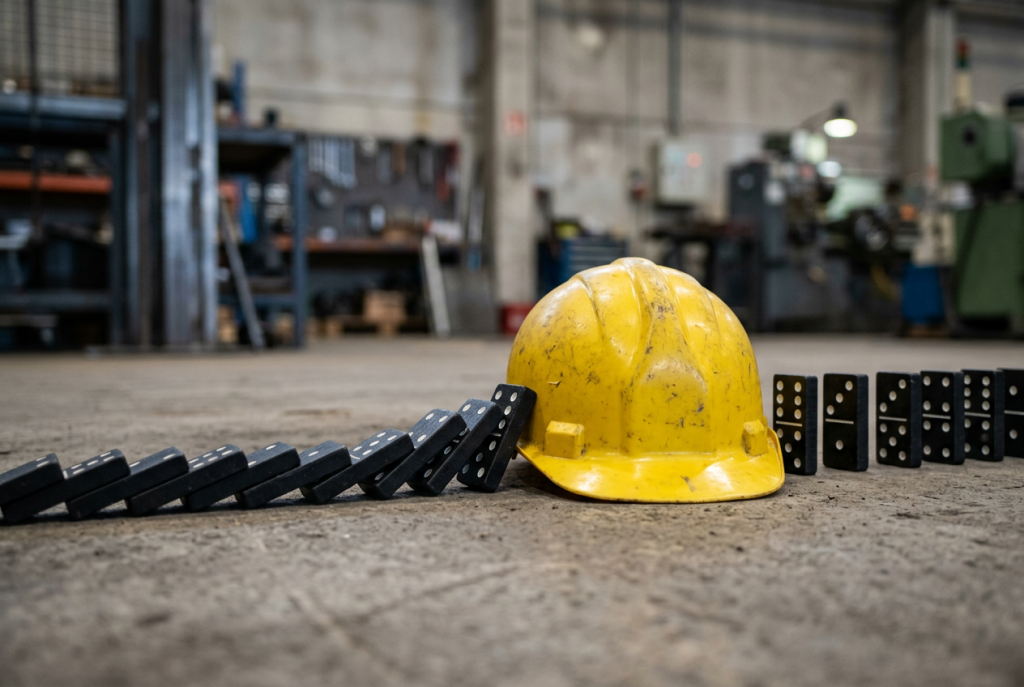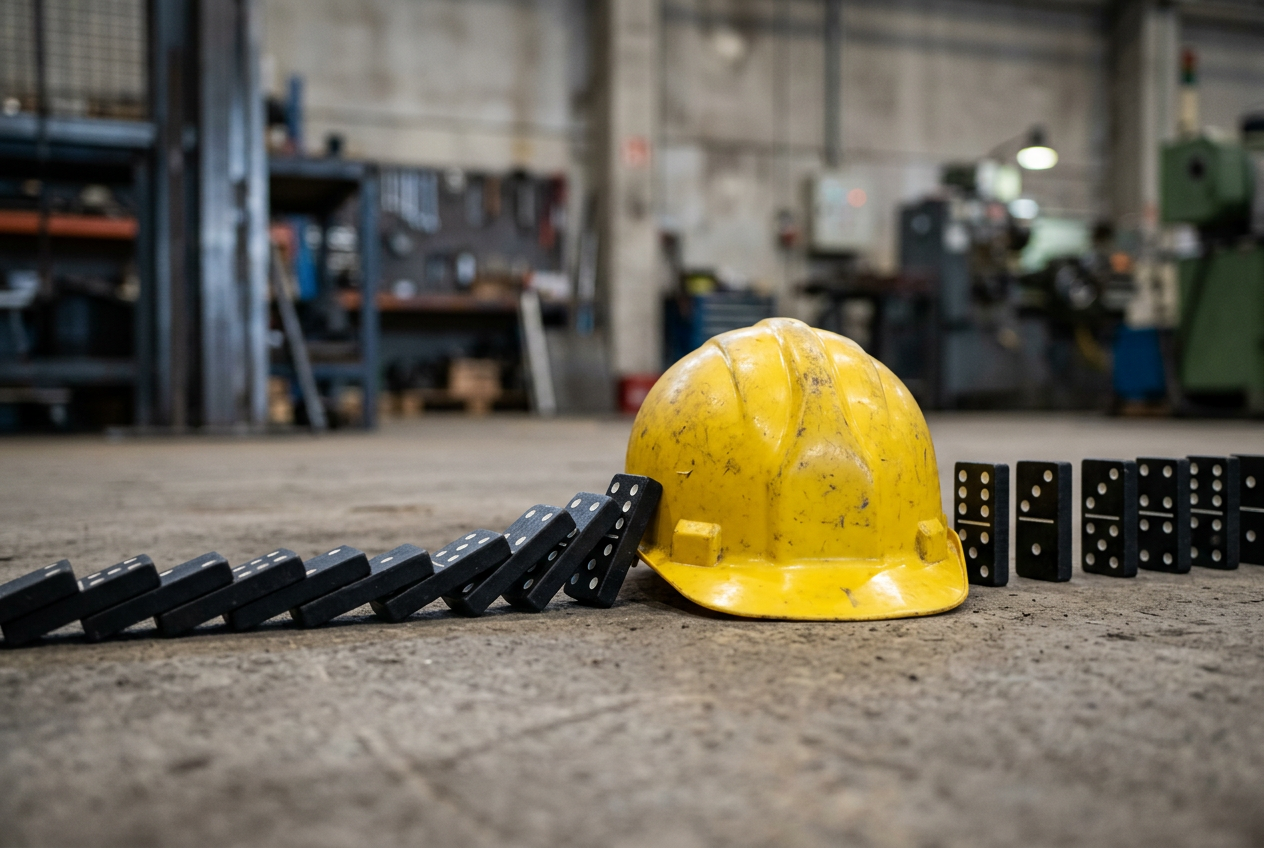
An eyewash station gets refilled for the third time this quarter. A machine guard sitting just outside its required clearance is adjusted, again. A near miss gets logged with barely a note. Each fix is legitimate in the moment, but a correction only addresses what’s visible, not whether it’s happened before, or whether something small is quietly becoming something bigger. That gap is exactly where a minor, recurring finding turns into a serious incident, and the warning signs are usually there, though not always recognized.
Correction and corrective action are the two terms for this distinction, and the idea isn’t unique to EHS: quality management, safety, and other operational disciplines all draw the same basic line between a quick fix and something that goes further. Not every issue is a big deal on its own, but a pattern of small issues might be, and knowing the difference is what separates a program that reacts to problems from one that actually gets ahead of them.
What’s the Difference Between a Correction and a Corrective Action?
A correction is the immediate, short-term fix: refilling the eyewash station, readjusting the guard, cleaning up the spill. It addresses the current situation directly, not the cause behind it, and for a one-off, low-risk finding with an obvious cause, that’s often genuinely enough.
A corrective action aims to eliminate the root cause behind a finding, a long-term solution meant to prevent recurrence rather than just rectify what’s visible today. Assessing which one a finding actually needs is crucial: a finding that keeps recurring, whether at the same location, the same piece of equipment, or across multiple sites, usually means something in the underlying process or procedures needs to change, not just the symptom in front of you. Identifying that early is essential, since a systemic issue mistaken for a one-off is how small findings turn into bigger ones.
Corrective Action vs. Preventive Action: A Different Question
The distinction between corrective action and preventive action is a different question which will not be addressed here. Suffice it to say that preventive action addresses a potential nonconformity, a future threat that hasn’t caused a problem yet, rather than responding to one that’s already occurred. Often bundled together, these terms yield the common acronym “CAPA.”
This article is specifically about knowing when a fix you’ve already made needs to go further.
Key Differences at a Glance
| Correction | Corrective Action | |
| Responds to | The current issue in front of you | The underlying reason it happened |
| Timeframe | Immediate action/fix | Requires investigation before action |
| Question it answers | “How do I fix this right now?” | “Why did this happen, and how do we stop it from happening again?” |
| Appropriate when | The finding is a one-off with an obvious, isolated cause | The finding recurs, or the cause isn’t obvious |
How Inspection Question Design Determines Which One You Need
Whether an inspection surfaces a one-off or a pattern often comes down to how the question was asked in the first place. A checklist item that only asks “Is the guard in place? Yes/No” captures the correction, but nothing else. It tells you the guard was missing; it doesn’t tell you if this is the third time this month or the first time ever.
A slightly different question changes everything. “Has this condition been noted at this location before?” or “How long had this condition likely existed?” turns a routine checklist into a diagnostic tool. That single addition is often the difference between an inspection that only produces corrections and one that actually surfaces the findings that need a corrective action.
This is closely tied to how audits and inspections are designed and run in the first place. The Key Differences Between Audits and Inspections covers how these two activities differ in scope and purpose, but the principle holds for both: the quality of the questions asked determines the quality of the signal you get back.
 Recognizing When a Quick Fix Isn’t Enough
A few signals reliably indicate the situation requires further action beyond a correction. Several aspects of a finding are worth assessing:
- It’s happened before, at the same location or on the same piece of equipment, a sign of recurrence rather than a one-off.
- A similar finding is showing up at other sites or on other equipment of the same type.
- The likely cause traces back to a process, a training gap, or a maintenance schedule, something systemic rather than a random event.
- The finding is minor on its own, but plausibly an early sign of a bigger risk still developing.
None of these require certainty upfront. They’re reasons to open an investigation, not conclusions. That’s exactly where Root Cause Analysis (RCA) comes in.
Why Root Cause Analysis Is the Bridge Between the Two
Consider a single-use eyewash station that maintenance keeps finding drained during routine checks, with no incident report on file showing anyone used it. The correction is straightforward: refill the station and move on. But that correction doesn’t explain the actual problem: why is a supposedly single-use unit draining with no record of use?
That question is exactly what separates a correction from a corrective action, and it’s also exactly the kind of question root cause analysis exists to answer. A few different root causes could explain the same finding, and each one points to a completely different fix. The unit could have a slow mechanical leak unrelated to any actual use, in which case the corrective action is a repair, and, just as importantly, a check of every similar unit across the facility for the same defect. Or a tamper-indicator on the handle, a piece of tape that breaks the moment the unit is actually triggered, could show the eyewash genuinely was used, meaning an employee experienced eye exposure and never reported it.
That’s a very different corrective action entirely: reinforcing incident-reporting expectations and understanding why an employee didn’t feel the incident was worth reporting in the first place. The same kind of question applies to something as simple as a fire extinguisher’s inspection tag repeatedly going missing: is it vandalism, a flawed tagging process, or something else entirely?
Without root cause analysis, an EHS team refilling that eyewash station repeatedly has no way to know which of these it’s actually dealing with, whether the root cause is mechanical or human error, or how much risk is actually involved. Root Cause Analysis: A Key Guide for EHS Leaders walks through methods like 5 Whys, Fishbone, Change Analysis, and others that move the response into the realm of genuine investigation rather than guesswork. Which specific method fits best varies by industry, by organization, and by how complex the problem is; for more complex or higher-consequence situations, the following tools are also common: fault tree analysis, failure mode and effects analysis, and operability analysis, sometimes called a HAZOP.
Whichever method is used, documenting the finding, the investigation, and the reasoning behind the resulting corrective action is what actually helps mitigate the chance of the same problem resurfacing.
The Role of EHS Analytics Tools for More Effective Corrective Actions
The eyewash station example points to a second, often overlooked opportunity: once a corrective action addresses one unit, the same question should be asked about every similar unit across the facility, not just the one that happened to get flagged. But inspection findings are only one source of this kind of signal, and not even the richest one.
Incidents and injuries almost always trigger an individual root cause analysis on their own — that part of the process is usually already in place. What trend analysis adds is a second layer: looking across many incidents together often surfaces a shared contributing factor that no single RCA would catch in isolation, making the next RCA, and the corrective action that follows it, considerably more effective.
 Near misses are closer to the opposite problem. Because the consequence didn’t materialize, they’re often logged and closed without a formal RCA at all, except in cases where the near miss is recognized as a Severe Injury or Fatality (SIF) precursor. That’s exactly why trend data matters here: a pattern across near misses can surface a systemic issue that no single one, viewed on its own, would have justified investigating.
Observations round this out. They’re informal and less structured than a scheduled inspection, but a steady stream of “see something” reports is a genuine source of data, not just a list of individual to-dos. Analyzed alongside inspections, incidents, and near misses, observations can help surface a developing issue while it’s still minor, before it grows into the kind of finding that shows up in an incident report instead.
Tracking all four sources together, whether a finding originates from a scheduled inspection or an incident report, by site, by asset type, or by the regulatory topic involved, helps EHS teams decide where further action is actually warranted, rather than treating every finding as its own isolated event. Issues that scale across an organization, showing up at multiple sites rather than just one, are exactly the pattern this kind of tracking is built to catch.
Treating this as a continuous improvement effort, not a one-time project, is what actually helps teams implement corrective action effectively and land on lasting solutions rather than repeat fixes. That’s true whether you’re running a single facility or a larger business with locations spread across the country.
Summary
Corrective Action vs. Correction: How Do I Know Which One a Finding Needs?
A correction is an immediate fix to the issue in front of you; a corrective action addresses why it happened. Start by asking whether this specific instance is a one-off with an obvious cause, if so, a correction is likely enough. If the same finding has occurred before, is showing up elsewhere, or traces back to something systemic like a process or training gap, that’s usually enough to determine that a corrective action, built on root cause analysis, is what’s actually needed.
Knowing the difference between a correction and a corrective action is only useful if the system tracking your findings can actually tell the two apart, and connect a recurring finding to the action that addresses it. Dakota’s Tasks & Action Items ties findings, whether from inspections, audits, or incident reports, to the corrective actions assigned against them, so a pattern like the one above doesn’t have to rely on someone happening to remember it. For a closer look at how to structure a corrective action once you’ve decided one is needed, see 3 Key Elements of a Corrective Action Plan.