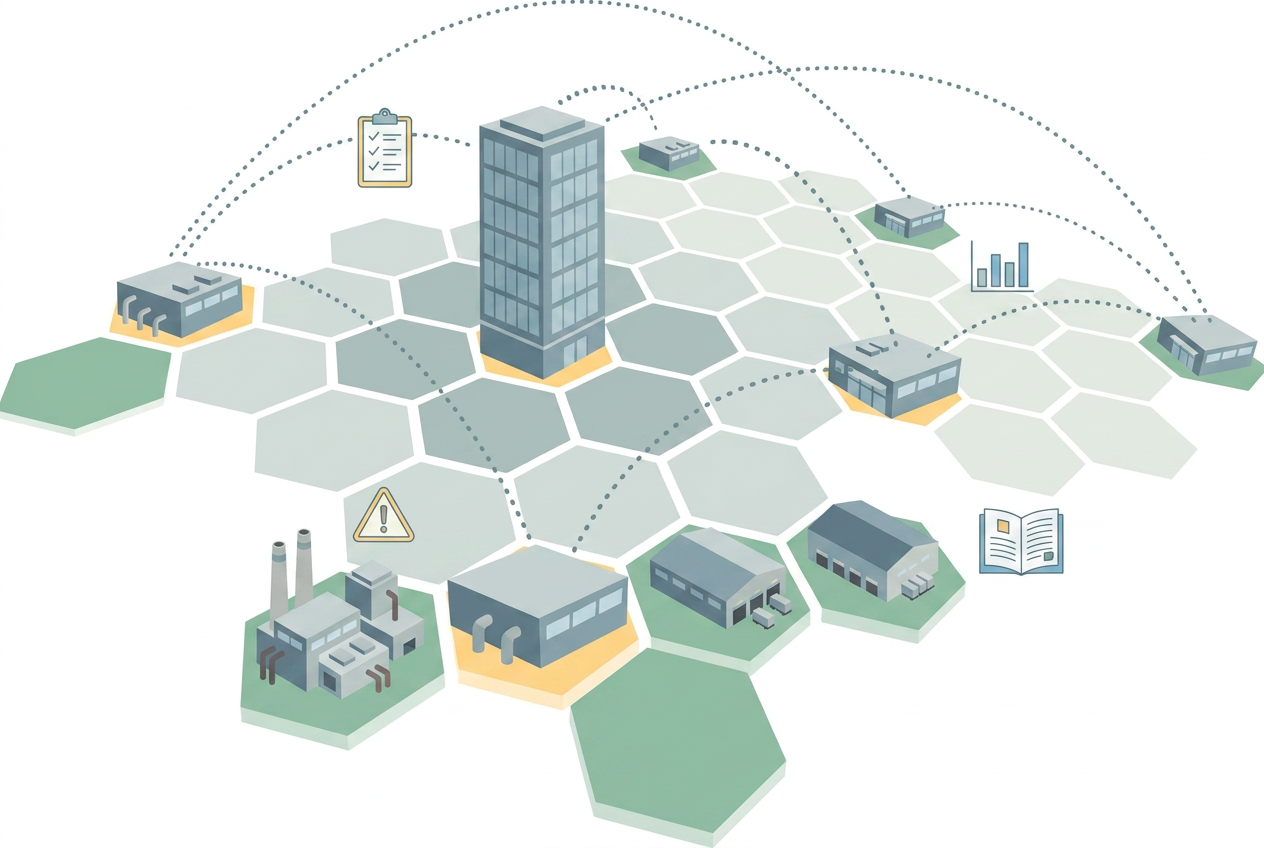
As organizations evolve, whether through acquisition, expansion, or restructuring, Environmental, Health, and Safety (EHS) leaders inevitably face a foundational question: how much of compliance and safety management should be run directly by corporate, and how much oversight, if any, should corporate maintain over what sites manage on their own?
The answer usually depends on the breadth, depth, and risk profile of the EHS function. Organization size, specifically the number of employees and facilities, is often the most practical starting point, since the right structure for a five-site regional operator looks very different than for a fifty-site national one. The nature of the operational footprint matters too, whether sites share the same processes, operate across multiple jurisdictions, or manage different waste streams by business unit.
A meaningful distinction also exists between EHS compliance, adherence to applicable regulatory obligations, and EHS operations, the execution of the day-to-day EHS programs. Treating both as if they require the same organizational structure is where most centralization debates go wrong. This article looks at each separately, making suggestions where one, the other, or a hybrid model may serve organizations best.
What Is Centralized vs. Decentralized EHS?
A centralized EHS program is one where a corporate function sets and manages the standards used across every location. It relies on shared processes and consistent data tracking, so leadership can see how the whole organization is performing.
A decentralized structure leaves that responsibility with individual regions, business units, or sites. Each uses its own methods and keeps its own records, often relying on the knowledge and expertise of local EHS professionals rather than centralized oversight. That flexibility comes at a cost: without consistent data, corporate visibility into compliance and safety performance is often limited.
Both models have strengths and weaknesses; and choosing between them isn’t binary. EHS Careers has a good breakdown of how organizations manage and staff for each. What matters more than the chosen structure is what’s being centralized or decentralized, because EHS programs cover two different kinds of work: meeting regulatory compliance obligations, and running day-to-day EHS management programs.
EHS compliance and tactical EHS execution don’t necessarily call for the same approach, as the comparison below shows.
| Centralized | Decentralized | |
| Regulatory compliance tracking | Consistent, corporate-visible, defensible across every site | Fragmented, inconsistent, hard to benchmark or defend |
| Tactical EHS execution | Rigid, may not fit local operations | Flexible, tailored to how each site actually works |
| Data & reporting | Single source of truth, real roll-up visibility | Difficult to aggregate, no reliable cross-site comparison |
| Best suited for | A consistent process for tracking and managing obligations, even when the obligations themselves differ by site | Day-to-day execution that genuinely varies by site |
The Case for Centralized EHS Compliance
Regulatory compliance isn’t a cookie-cutter exercise, as no two sites’ obligations look exactly alike. Permits are inherently local, tied to a specific facility’s equipment, processes, and waste streams impacting the surrounding community. Permits frequently incorporate federal and state requirements as their baseline, layering broader regulatory obligations on top of what’s already site-specific. Centralizing compliance doesn’t mean pretending any of this is uniform.
What can, and should, be centralized is the EHS compliance management process: consistent regulatory change management, compliance activity tracking, and analytics that surface Regulatory Readiness and penalty risk across every site. Left decentralized, that process breaks down fast. When each site independently interprets requirements, tracks regulatory changes, and manages compliance activities inconsistently, corporate has no reliable visibility into compliance risk until an audit or a violation uncovers the gap.
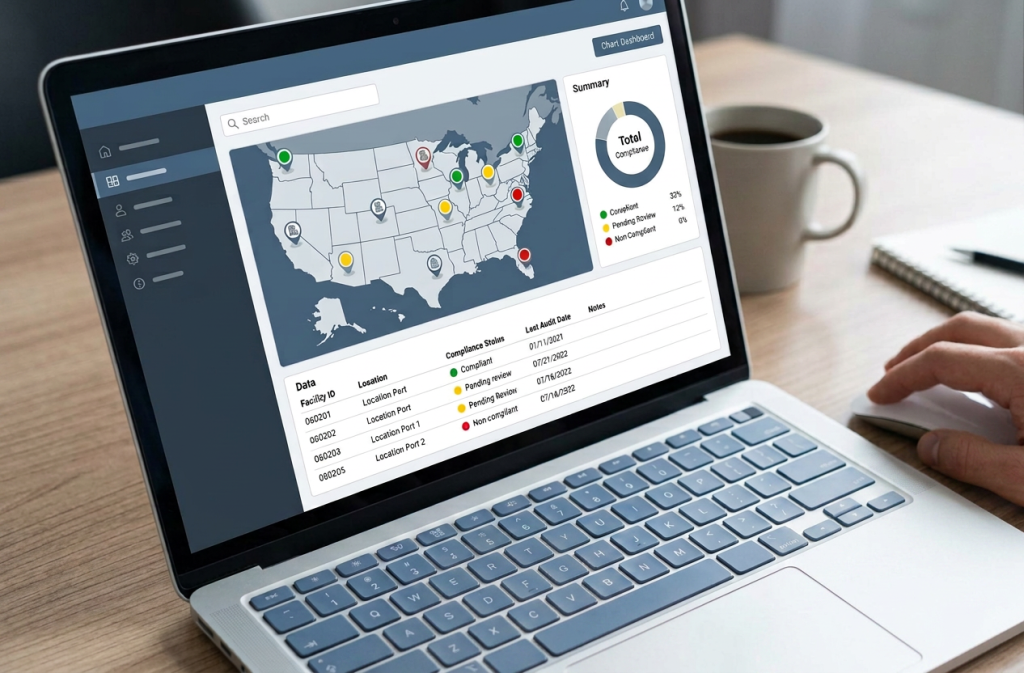 A single regulatory change management system that tracks applicable requirements and pushes updates as regulations shift, paired with one source of truth for EHS compliance calendars, closes that gap directly: every site works from the same accurate, current information instead of duplicating research independently, and leadership gets a real, defensible view of where obligations stand company-wide.
The stakes rise with scale and risk. A multi-site footprint spanning several states means obligations multiply and vary by jurisdiction, making a fragmented approach harder to defend. Industries handling hazardous or reactive chemicals feel this most acutely, where inconsistent tracking isn’t just inefficient, it’s a safety and liability risk. A centralized EHS compliance program also strengthens risk management, since it’s easier to identify risks across the portfolio when the same analytics apply at the corporate level everywhere, rather than each site flagging concerns independently, or not at all.
None of this requires a single global program, a separate concern for organizations operating internationally. For most U.S.-based organizations, the real question is simpler: does compliance tracking happen centrally and correctly, or independently at every site, with all the duplication and risk that implies?
Why a Decentralized Organizational Structure Fits Day-to-Day Operations
While EHS compliance is a “should” for centralization, day-to-day operational programs are a genuine “it depends,” shaped by organizational factors like company size, industry, and how much variation exists across multiple sites.
Conducting inspections, tracking incidents, delivering employee training, and other tactical EHS functions need to reflect real conditions on the ground: equipment, facility layout, hazards, and the workforce involved. A checklist built for a corporate office won’t transfer to a manufacturing floor, and a single-shift training cadence may not suit a facility running three shifts around the clock. Multiple factors, from operational needs to local expertise, make a rigid, one-size-fits-all model a poor fit here.
This is especially true for organizations managing a wide range of site types under one umbrella, from corporate offices to distribution centers to industrial plants. Managing EHS across multiple sites already means accounting for real differences in size, risk profile, and operational maturity between locations. Forcing every site into an identical operational program tends to produce compliance on paper rather than one that reflects what’s happening at each facility.
 A decentralized approach lets local teams respond quickly to safety issues as they arise, rather than waiting on direction from corporate. Decision making is faster at the site level, and since the people closest to the work are best positioned to spot risks, safety improves too. Smaller companies in particular may lean toward decentralized models by necessity, because they lack a dedicated corporate EHS team to centralize around.
That doesn’t mean sites should operate without oversight. It means the tools and templates should be flexible enough to be configured for local needs, while still rolling up into the same system corporate relies on for visibility. Standardization at the level of the tool, not the specific execution, is what improves efficiency and promotes a stronger safety culture.
The Best Practice: Centralized and Decentralized Working Together
These two key elements don’t have to conflict, they require treating compliance and operations differently rather than applying a single organizational design to both. The result is a hybrid model: a unified approach to regulatory compliance paired with a decentralized approach to daily execution.
This is how Dakota’s EHS Compliance solutions are designed. A centralized regulatory database, researched and maintained by in-house experts, uses Decision-Tree-Logic℠ to determine what applies at each facility, so every site works from the same accurate, current source of truth rather than independently researching requirements. Legal registers and compliance calendars update automatically as regulations change, and Regulatory Readiness scoring gives corporate leadership real visibility into risk before it becomes a violation, supporting stronger risk management company-wide.
At the same time, the tools used to execute the program, inspection checklists, audit protocols, incident workflows, are configurable at the site level, so each facility can run its program in a way that reflects its operations, without losing the shared data and oversight that make the whole system defensible.
Centralize what needs to be consistent. Let the rest flex.
Frequently Asked Questions
What Is the Difference Between a Centralized and Decentralized EHS Program?
A centralized EHS program is managed by a corporate function that sets standards and tracks data consistently across every site. A decentralized structure leaves that responsibility with individual regions, business units, or sites, each managing its own methods and records. Most organizations don’t operate purely one way or the other; the more useful question is which parts of the program, compliance or day-to-day operations, benefit from each approach.
Does Company Size Affect Whether EHS Should Be Centralized or Decentralized?
Usually. Organization size, specifically the number of employees and facilities, is often the most practical starting point for this decision. A small, single-site operation has little need for a formal centralized structure, while a fifty-site national operator typically can’t maintain consistent compliance without one. The right answer also depends on how much variation exists across sites, not headcount alone.
What Is the Best Practice for Structuring an EHS Program?
Centralize EHS compliance management, since regulatory tracking benefits from consistency and a defensible, single source of truth, and let day-to-day operational programs like inspections and training flex by site to reflect differences in equipment, facility layout, and workforce. This hybrid model gives corporate the oversight it needs without forcing every facility into an identical process.
Visit our Product Tour Library to see how Dakota’s EHS management solutions bring corporate consistency to regulatory tracking while giving sites the flexibility to run inspections, audits, and incident management their own way, or request a demo.